On the dancefloor you learn fast what theory often only claims: freedom isn’t abstract. Freedom is infrastructure. It has a temperature, a rhythm, rules that don’t taste like control but like protection. It lives in small gestures that disappear into the bass and still hold everything together: someone makes space without pushing. Someone checks your face, just to see if you’re still here. Water moves hand to hand. A no doesn’t get negotiated. Friends get gathered. Boundaries aren’t treated like a vibe-killer, but like the thing that makes the vibe possible in the first place.
And that’s where Tonja Wetzel‘s line lands: „Sit on the fist that oppresses you”. Not as self-destruction, but as a tactic: not swallowing pressure in silence, but pulling it back into your own body – as a decision, as a stance, as „I’m here and I’m not moving”. You turn what’s meant to shrink you into presence. You turn fear into ground.
„Sit on the fist that oppresses you.” – Tonja Wetzel
And pleasure belongs here, because it’s never only private. Pleasure is a sensor for where power sits – and a tool to shift it. If oppression trains you to be small, quiet, „easy”, then pleasure can be the opposite: loud, dirty, tender, demanding. Not as a performance for anyone, but as a reclamation. A body-politics that says: I’m not here to be endured. I’m here to feel.
Pleasure can be soft, but it isn’t harmless. It can draw lines where there used to be only adaptation. It can make a no so clear it stops being negotiable – and a yes so conscious it can’t be mistaken. Pleasure can mean: I choose closeness, but on my terms. I choose risk, but not without care. I choose surrender, but not without language. And that’s why pleasure is part of braver spaces too: because spaces are only truly free when desire isn’t punished, when consent isn’t debated, when vulnerability isn’t exploited.
And being trans sits right in the middle of this question of space and body. Not as an „identity topic” you tick off once, but as daily reality: being read, misread, stared at, commented on, checked. Trans bodies are constantly negotiated – at doors, in bathrooms, in looks, in „just curious” questions. That’s why trans freedom is so concrete: the right to exist without explanation. The right to be desired without being fetishized. The right to say no without punishment. The right to say yes without it being taken away from you. Trans isn’t a side note to feminism – trans is the stress test for whether feminism actually means liberation.
Maybe that’s the core: the fist that oppresses you wants you to split from yourself – from your body, your desire, your voice. To „sit on the fist” also means refusing that split. Not disappearing. Not freezing. Staying, sensing, choosing. Pleasure not as escape, but as proof that you belong to yourself.
And queer house isn’t just a soundtrack for that – it’s a kind of room-discipline. Berlin has its own grammar: doors, looks, codes, who „fits” and who doesn’t. Queer house reminds us that belonging can’t be curated like a lineup – it has to be built like a floor: making space instead of sorting people out, respect instead of tests. 4/4 as everyday logic: repetition until it lands. Groove as practice in closeness. And if we take that seriously, it also means: the music obligates us to the present tense of our spaces. Not only „hands in the air”, but hands off when it’s not wanted. Not only „everyone’s welcome”, but the question of who’s actually held when it gets tight – at the bar, in the darkroom, on the way home.
McKenzie Wark calls this feeling femmunism: a mix of queer theory, rave culture, and communist longing – not as party-philosophy, but as a real proposal. The dancefloor becomes a place where we don’t just imagine another society, we trial-run it. Not „abolish gender” as a new purity fantasy, but abolish compulsory genders and the hierarchies attached to them: who gets to be loud, who gets touched, who gets believed, who gets protected, who gets turned into decoration.
When Wark talks about ketamine femmunism in queer techno scenes, it sounds like a meme – but it’s really a clue about collective experience. About that strange, warm knowledge that appears when bodies move together and you suddenly feel: we’re not just individuals with opinions, we’re a system of relations. And systems can be built differently. Not perfect, not clean, not without friction – but different.
And Wark goes one step further, to the place where it actually hurts – and where it can actually become free: where being a bottom isn’t read as „less”, but as a choice. A practice. A form of power that doesn’t come from hardness, but from deliberate vulnerability. Getting fucked not as submission, but as an active, risky, self-determined act. Not passive, not „for you”, not as proof – but as your own terrain: I choose what is with me and what is in me. I set boundaries. I say yes, I say no. I choose tempo, context, conditions. I turn pleasure from commodity into language.
„Bottoms aren’t less – we’re the ones choosing the terms: what comes in, what stays out and how pleasure becomes power.“ – DJ handbag
That’s where braver spaces come in. Not „safe” as a marketing promise, but spaces brave enough to take responsibility seriously. Braver spaces don’t mean „anything goes”, they mean „we mean it”: consent isn’t optional, boundaries aren’t negotiable, care isn’t just a word on the flyer. And at the same time: we don’t pretend we’re finished. We learn. We correct. We repair. We do better because we have to – not because it looks good.
Because the truth is: oppression doesn’t always show up in uniform. Sometimes it shows up as habit. As a look. As a grab that „wasn’t meant like that”. As door policy inside people’s heads. As hierarchy that sneaks into the most intimate moments. And then the question isn’t only how we fight it – but how we don’t let it shape us. How we build rooms where we don’t automatically reproduce the rules that keep us small.
Braver spaces are dancefloor logic in everyday life: you can let go because you know someone’s paying attention. You can be yourself because the rules aren’t working against you. You can make mistakes without it being consequence-free – and without the most vulnerable people paying the price every time. That isn’t softened. That’s radically practical.
Feminism, queer, rave: not as a theory block you cite, but as a practice you feel. In the bass, in eye contact, in „you good?”, in a clear no, in a shared yes. In the way we build rooms that don’t just let us in – but hold us.
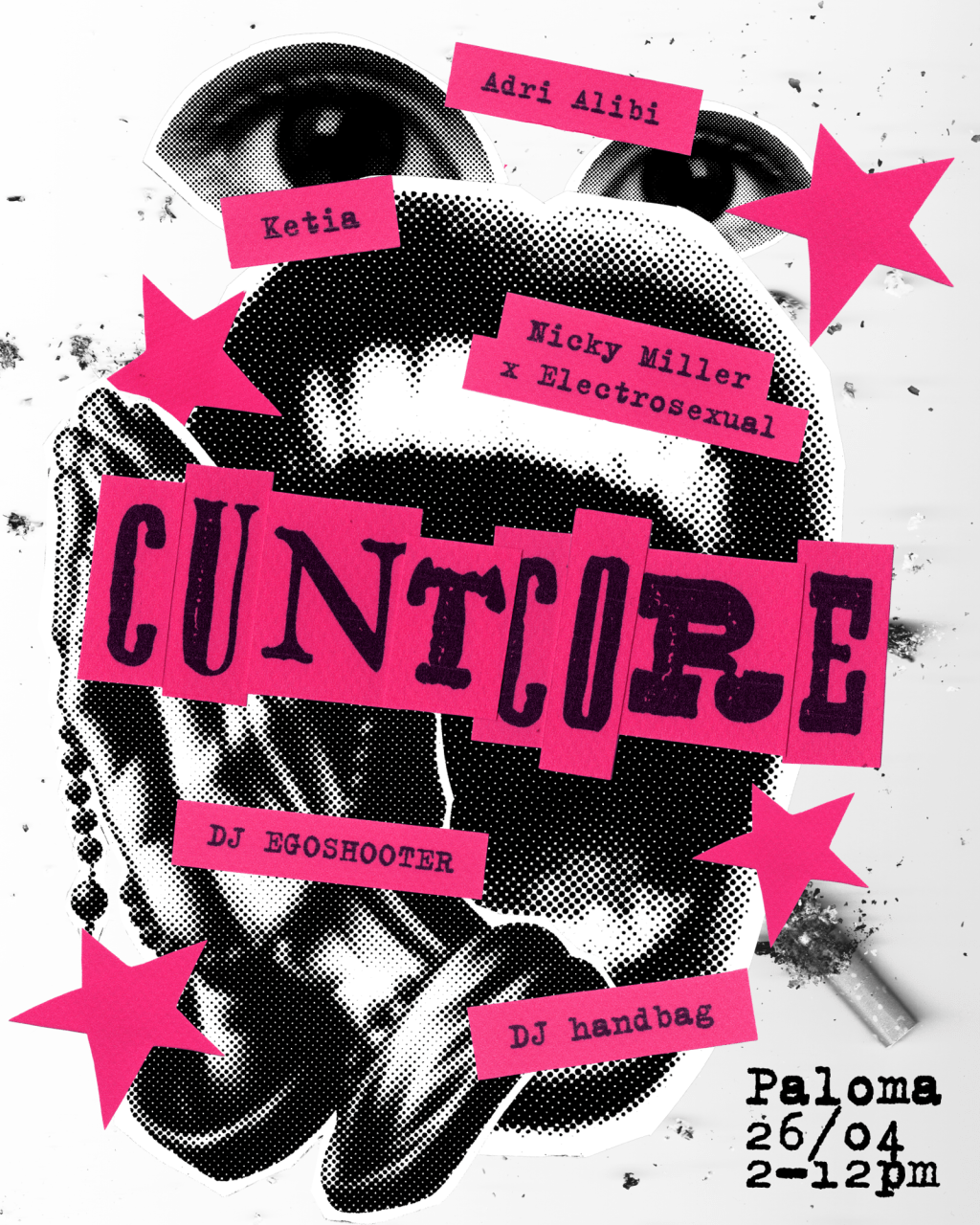
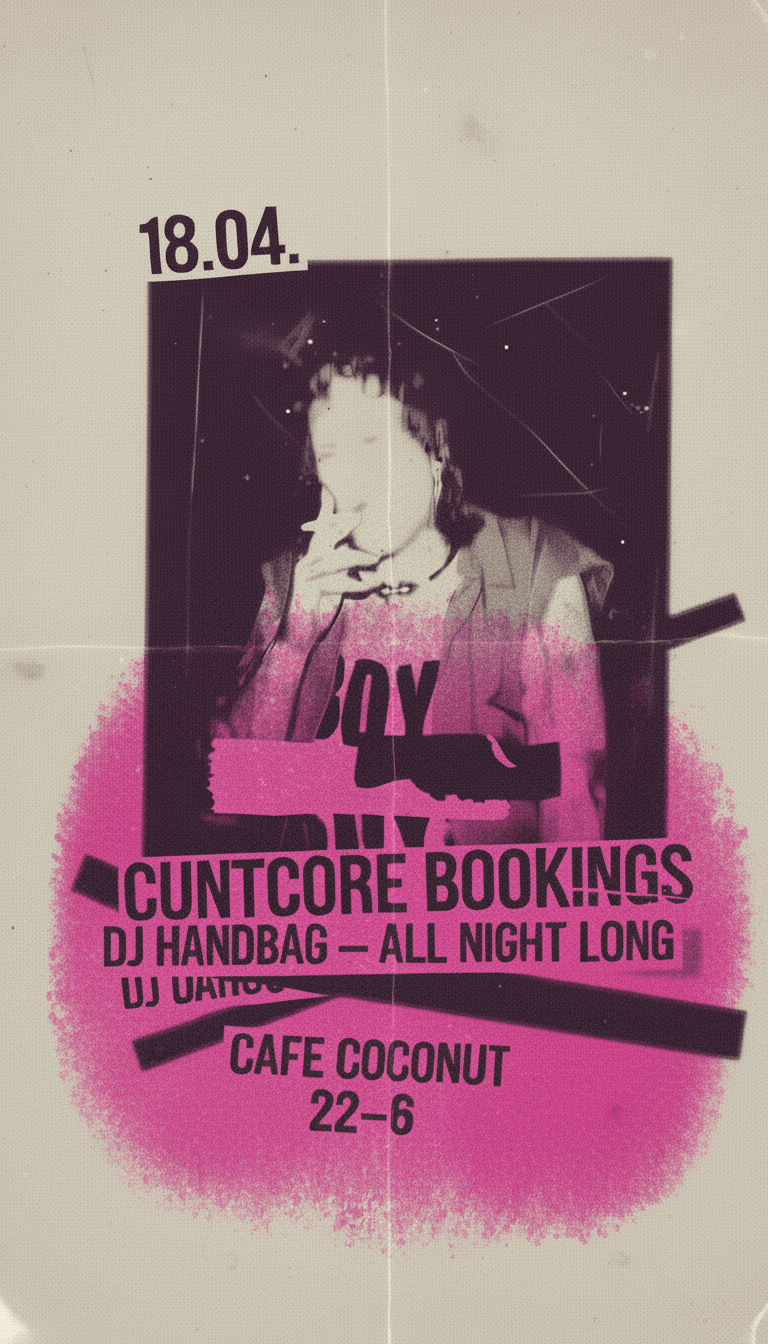

 CUNTCORE
Hinterlasse einen Kommentar