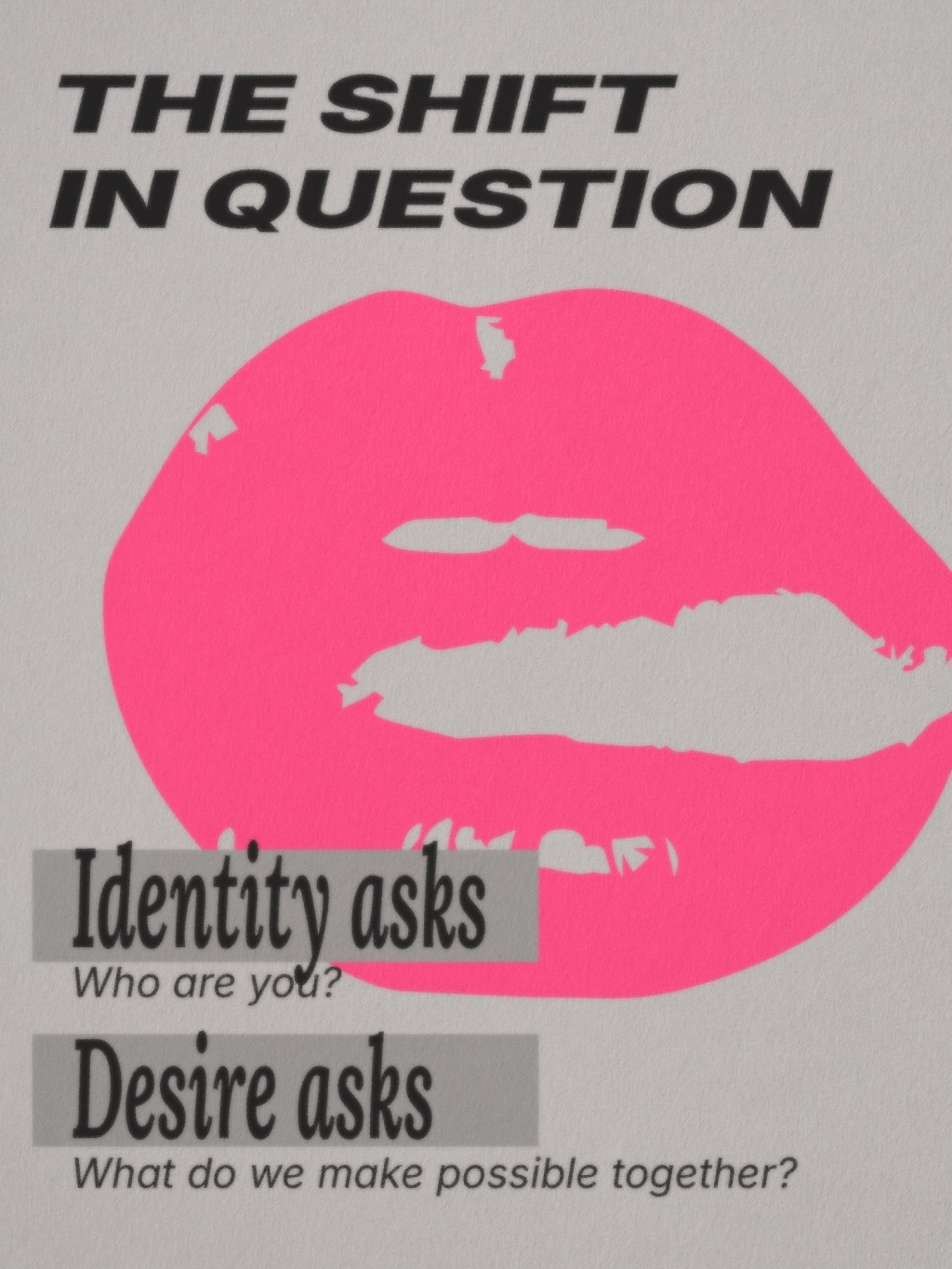
A shift in the question
Identity politics asks „Who are we“? It’s a necessary question when the world refuses to recognize you, when institutions misname you, when safety and access depend on legibility. Identity can be a shield, a map, a legal tool, a way to find your people.
Desire politics asks a different question: „What do we make possible together?“ Not in the abstract, but in the room, in the body, in the aftercare, in the rent, in the door policy, in the playlist, in the way someone is touched – or not touched – without consequence.
This isn’t „desire instead of identity“. It’s desire as the störsignal inside identity: the part that won’t stay still, the part that refuses to be reduced to a label, the part that keeps insisting on contact, contradiction, appetite, grief, tenderness and risk.
Away from labels as endpoints, toward practice as evidence.
Away from treating identity as the final answer.
Toward treating identity as context.
Identity describes conditions: how you are read, what you’re denied, what you’ve survived, what you’re expected to perform. But identity becomes brittle when it turns into a moral scoreboard – when it becomes a way to prove purity, to win arguments, to avoid intimacy, to outsource responsibility to the correct vocabulary.
Desire politics is less interested in the performance of correctness and more interested in the conditions of contact. It asks:
• What do you want – really – and what does it cost you to admit it?
• What do you need in order to be safe enough to want anything at all?
• What are you trying to control when you say you’re „just being principled“?
• What is being regulated here: pleasure, access, voice, space, money, time, touch?
Desire politics is not a permission slip. It’s not „anything goes“. It’s a demand that we stop pretending harm happens only because people used the wrong words. Harm also happens because of power, scarcity, coercion and the quiet normalization of who gets to take and who is expected to adapt.
Desire is political because it is policed
Desire is not a private, innocent force floating above history. Desire is shaped by class, race, migration, disability, trans experience, trauma and the micro-economies of nightlife. It is shaped by who can afford to experiment, who is punished for being visible, who is fetishized, who is ignored, who is believed.
That’s why desire politics matters: it reveals where pleasure is permitted and where it is punished. It shows how „community“ can become an alibi for exploitation. It shows how „safety“ can be used as a brand while labor is extracted, boundaries are blurred and accountability is outsourced.
Identity politics often fights for recognition. Desire politics fights for material conditions that make recognition meaningful: housing, healthcare, harm reduction, fair pay, braver spaces, real consent cultures and the ability to say no without social death.
The aesthetic is the ethic: what we set in motion
In theatre, there’s a principle sometimes called Chekhov’s gun: if you place a gun on the wall in Act I, it must matter later. In community, in nightlife, in intimacy, the same is true. What we introduce into a space – norms, jokes, substances, hierarchies, flirtation, favoritism, silence – doesn’t stay neutral. It becomes a plot device. It will go off somewhere.
Desire politics is a commitment to consequence. Not punishment. Consequence.
It asks: What are we setting in motion when we reward certain kinds of charisma? When we ignore certain kinds of discomfort? When we treat boundaries as vibe-killers? When we confuse intensity with intimacy?
And it asks the harder follow-up: What would we need to change so the same gun doesn’t keep firing?
Less moral theatre, more relational literacy
Less call-out as spectacle.
More repair as practice.
Less „I’m right, therefore I’m safe.“
More „I’m accountable, therefore we can stay in contact“.
Desire politics doesn’t abolish conflict. It changes what conflict is for. Not a purity test, but a feedback system. Not exile as the default, but boundaries with teeth and pathways to repair.
This requires relational literacy: the ability to name what’s happening without turning it into a trial. The ability to feel shame without weaponizing it. The ability to hold anger without turning it into domination.
It also requires us to admit that sometimes „politics“ becomes a way to avoid the terror of wanting. If I can keep everything at the level of discourse, I never have to risk being seen.
Desire politics is the opposite of that avoidance. It is the courage to be specific.
Fukinsei, yūgen, seijaku, shibui: the politics of restraint
There’s an aesthetic lineage that values asymmetry, quiet depth and restrain – principles often described as fukinsei (productive imbalance), yūgen (suggested depth), seijaku (stillness) and shibui (understated elegance).
I’m not invoking these as exotic decoration. I’m naming a discipline: a refusal of maximalism as virtue.
In many political scenes, intensity becomes currency. The loudest analysis wins. The most catastrophic framing becomes proof of seriousness. The most totalizing language becomes a badge.
Desire politics practices a different craft:
• Fukinsei: We allow the room to be uneven enough to reveal what power is doing. We don’t smooth everything into a single story.
• Yūgen: We respect what can’t be fully articulated. Not everything real is immediately speakable.
• Seijaku: We build pauses into our culture – time to cool down, to check in, to metabolize, to not escalate.
• Shibui: We choose clarity over performance. We don’t over-explain to prove innocence.
This is not softness. It’s precision.
A practical politics: from gatekeeping to conditions
Here’s what desire politics could looks like when it stops being a concept and becomes a culture.
1) From gatekeeping to shaping conditions
Less „Who is allowed?“
More „What conditions make this safer, fairer and more alive?“
That means transparent pay, clear roles, accessible spaces and policies that don’t rely on whisper networks.
2) From consent as a rule to consent as a living culture
Less checkbox consent.
More ongoing consent.
Consent is not a one-time transaction; it’s a shared language: checking in, reading shifts, making exits easy, treating „no“ as information – not betrayal.
3) From moralizing pleasure to politicizing it
Less „good desires vs bad desires.“
More „what’s the power situation here?”
Desire politics doesn’t shame pleasure, but it also doesn’t romanticize it. It asks who gets to be complicated and who gets punished for it.
4) From representation to redistribution
Less symbolic inclusion.
More material support.
Lineups matter, yes. But so do fees, travel budgets, childcare, access riders and who gets booked again.
5) From purity tests to repair pathways
Less exile as default.
More boundaries plus repair.
Some harm requires removal. Some requires mediation. Some requires time. Desire politics builds structures for this instead of improvising in crisis.
6) From language as a badge to language as a tool
Less jargon as proof.
More language that helps people act.
We keep words that increase safety and drop words that only increase status.
7) From identity as armor to intimacy with boundaries
Less identity as performance.
More vulnerability with responsibility.
A lot of violence is defended as „just how I am“. Desire politics replies: Maybe. And what are you going to do about it?
The point isn’t to be unnameable. It’s to be ungovernable by simplification
Desire politics doesn’t ask us to abandon identity. It asks us to stop treating identity as the only site of politics.
Because the real question is not whether we can name ourselves correctly. The real question is whether we can build a world where naming isn’t the price of admission.
So: less fixation on the perfect position.
More commitment to the actual encounter.
Less politics as self-branding.
More politics as shared consequence.
And maybe the most difficult shift of all:
Less „Tell me what you are.“
More „Tell me what you need and what you’re willing to be responsible for.”









Kommentar verfassen